
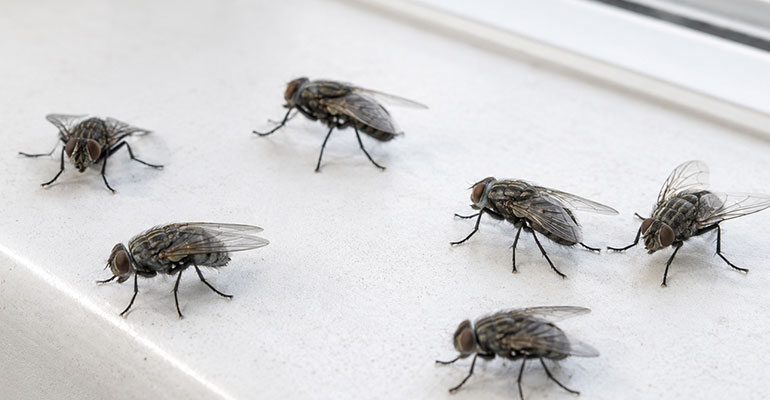
Flies: a health risk that should not be underestimated
When you see a fly circling in your kitchen, landing on a worktop or near food, it's not just a simple summer nuisance. In reality, each fly can transport more than 100 pathogens: bacteria like Escherichia coli, Salmonella, Listeria, and Shigella, picked up on decaying waste, droppings, or carrion, then deposited on your food or surfaces by simple contact or regurgitation. In professional environments—especially in the food industry, collective catering, or healthcare—this poses a real problem: beyond the image of cleanliness, it's public health and strict regulatory compliance (HACCP, regulation CE 852/2004) that are at stake.
Désinsectiseur mouches: equipment or service? We cover both
The term “désinsectiseur mouches” often creates an ambiguity: some are looking for a professional UV lamp device to install in their premises, others need a pest control company to get rid of an infestation. At Need's Protect, we provide both, ensuring that the equipment and the treatment work together. We install and maintain certified insect killers in Seclin and the surrounding area, and we also intervene in curative treatment when the situation requires more than just trapping.
Identifying the flies present: not all flies are the same
Training for proper identification is at the heart of our intervention. Not all flies carry the same risks and their control methods differ:
- House fly (Musca domestica): the most common. It breeds in organic waste (garbage, compost, leftover food). It mechanically transports pathogens from one surface to another.
- Bluebottle (Calliphora vomitoria): often found in butcheries, fishmongers, or near animal carcasses. It can cause myiasis: its larvae develop on living tissue or exposed meat. In a professional context, its presence is taken very seriously during health inspections.
- Greenbottle (Lucilia sericata): similar to the bluebottle, but also linked to livestock waste and manure. It also lays eggs on wounds in animals.
- Drain fly (Psychodidae): small flies that swarm around sinks and drains. Unlike fruit flies, they come from biofilms that form on pipe walls. A simple flytrap doesn't solve the problem; the drain must be cleaned.
- Stable fly (Stomoxys calcitrans): biting fly that attacks livestock and can also bother humans. In agricultural areas around Seclin, its presence can affect animal welfare and productivity.
- Fruit fly (Drosophila): attracted by fermenting fruits or sour residues. A sign of hygiene issues in storage areas or bars.
Life cycle: why infestations explode in summer
Understanding the fly's development is essential. A house fly can lay up to 500 eggs at a time in moist organic matter. In warm conditions, the egg hatches in 8-20 hours, the larva (maggot) feeds for 3-5 days, then pupates. After 3-6 days, an adult emerges. The cycle can be as short as 7 days. In a restaurant where a bin is left open overnight, a single fly can produce hundreds of offspring in a week. Without breaking the cycle, you'll never regain control.
Signs that should alert you
You are probably dealing with an infestation if you observe:
- A large number of flies suddenly indoors, even with windows closed.
- Presence of maggots in a bin, behind an appliance, or in an unnoticed food item.
- Small black spots (excrement) on walls, windows, or lighting fixtures.
- A persistent buzzing and attraction to certain spots despite cleaning.
- In livestock buildings: flies agglomerating on animals, particularly in the heat of the day.
Why home remedies can't always be enough
We often see business owners or individuals multiply homemade traps, or buy electric swatters and supermarket UV lamps. Unfortunately, these solutions have their limits: they often only eliminate a fraction of adult flies without addressing the source. If larvae continue to develop in a poorly sealed waste container, a clogged drain, or compost too close to the terrace, the cycle continues. Moreover, electrical grid insect killers can cause hygienic issues in kitchens: dead flies can fall into food and contaminate it. That's why regulations for food establishments recommend adhesive board insect killers, positioned away from food preparation areas.
Another common mistake: using aerosols or pyrethrin sprays extensively. In addition to being less effective than targeted biocides, they can contaminate surfaces and, in food environments, violate hygiene regulations. Coating a kitchen with insecticide is illegal and dangerous. Professional solutions are precisely dosed and applied in a controlled manner.
Field experience: recently, a restaurant on the outskirts of Seclin believed their terrace fly problem was unsolvable. In reality, the source of the infestation was a sorting area for bio-waste installed in the back alley, poorly managed by the community. Without a thorough inspection, the professional would have continued to use their UV lamp in vain, never understanding why the flies kept coming back. At Need's Protect, we always start with a methodical diagnostic.
Our professional method: integrated fly management
We apply the principles of integrated pest management (EN 16636, CEPA) in four stages:
1. Thorough inspection
A technician comes to your site to identify the fly species, locate all breeding sites (bins, drains, compost areas, livestock effluent, damaged seals, unprotected windows, etc.), and map high-risk areas. This is done discreetly and with full respect for safety and privacy.
2. Tailored action plan
Depending on the diagnosis, we combine several measures:
- Exclusion: installing mosquito netting, strip curtains (rideaux à lanières) for doors, sas systems to cut off the insects' path. In agro-food industries, this is the first line of defense required by HACCP.
- Physical capture: positioning professional UV glue board insect killers (désinsectiseurs à plaque glue). These devices attract flies with a specific UV tube and trap them on a sticky board, preventing them from falling. The tube is replaced annually and the glue board is changed regularly according to a maintenance contract, ensuring traceability.
- Targeted treatment: use of TP18 biocides (insecticides) in the form of controlled spraying or fogging, applied by a Certibiocide-certified operator. We only use products authorized by the Ministry of Ecological Transition, and in strict compliance with safety data sheets. Treatments are applied away from food contact areas and outside business hours to avoid any contamination.
- Source management: advice on managing waste, cleaning cycles for containers, closure of bins, sanitization of drains, and treatment of breeding sites in livestock effluent (fumier, lisier).
3. Monitoring and preventive maintenance
For food establishments, we provide a nuisibles logbook (registre nuisibles) meeting the requirements of the PMS (plan de maîtrise sanitaire). Regular visits, tube changes, glue board replacements, and activity monitoring maps are documented to prove compliance in case of official inspection by DDPP. Every intervention is documented: date, time, product used, batch number, location, and observations. This documentation, auditable at any time, is your legal safeguard. We also provide annual reports to help you identify trends and adjust your practices.
4. Verification and continuous improvement
After each intervention, we adjust the strategy if necessary. We are reactive and can be reached at 09 78 23 23 23 for any questions or emergency interventions during summer months.
Special case: bluebottles in butcheries and fishmongers
In meat and fish trades, bluebottles are the main enemy. Their ability to lay eggs on an exposed product in just minutes is a constant threat. Our technicians have witnessed situations where a simple neglected joint on a cold room door became the entry point for an infestation. The solution is not to spray more but to ensure proper closing of chilled cabinets, rapid disposal of parures and offal, and install adhesive board insect killers near receiving areas. We also remind of the obligation to keep doors closed and avoid exposing products to ambient air for too long—a simple habit that often lapses during rush hours.
Terrace and waste: an underestimated combo
In bars, restaurants, and hotels in Seclin, the terrace is a key asset. But if the terrace is adjacent to a communal bin area or a poorly maintained compost corner, the fly pressure becomes structural. We often recommend moving the bin as far away as possible, using closed-lid bins, increasing cleaning frequency, and installing an exclusion sas or air curtain if feasible. On the terrace itself, our UV glue board devices can be strategically placed without harming the customer experience.
Drain flies: don't confuse them with fruit flies
A very common case: small flies flying around a siphon. They are often mistaken for fruit flies, but they are psychodid flies. Insecticides have little effect because the larvae are protected by the biofilm inside the pipes. The only effective solution is to thoroughly clean the pipes with an enzyme-based cleaner and, if necessary, use a larvicide approved for this use. We conduct this treatment following a strict protocol to avoid any contamination of the water network.
Why drain cleaning must be part of your HACCP plan
Too many establishments neglect their drains until they smell. However, biofilm can form within days, and fly larvae feed on it continuously. A simple hot rinse won't eliminate it. We recommend an enzymatic cleaning protocol as a preventive measure, supplemented by periodic larvicide injections under controlled conditions. Our technicians can train your cleaning staff to do this correctly between our visits.
Our equipment: professional insect killers adapted to every situation
We install products from the leading European brands, chosen for their effectiveness and their compliance with electrical safety standards (NF EN 60335). The choice between an adhesive board unit and an electric grid unit depends on the sector: for kitchens, food industries, and healthcare, the adhesive board is mandatory to prevent insect fragments from contaminating surfaces. For less sensitive areas (warehouses, loading docks, livestock buildings), an electric grid can be used but must be placed far from food and cleaned regularly. Our maintenance contracts guarantee tube replacement and a recorded history, an essential document for HACCP audits.
Maintenance: the forgotten factor
A UV insect killer, even professional, loses its effectiveness if the tubes are not replaced annually. After one year, the UVA emission drops by more than 30%, and the attraction capacity collapses. Additionally, a saturated glue board loses its adhesion and can itself become a breeding ground for bacteria. Our maintenance contract includes tube and board renewal, along with a record sheet that serves as legal proof for hygiene audits. This is not an option; it's an obligation for HACCP compliance.
Agricultural context: stable flies and intensive livestock
In the rural areas around Seclin, livestock farmers often face infestations of stable flies and greenbottles. These flies not only stress animals, reducing productivity, but they can also transmit diseases. Our approach combines larvicidal treatment of manure and slurry with the installation of capture devices and, when possible, the use of parasitoid wasps as biological control. Each system is studied according to the type of livestock (cattle, pigs, poultry) and local regulations.
Flies in healthcare and sensitive environments
In hospitals, EHPAD, and crèches, the presence of flies is more than a nuisance: it's a risk factor for the most vulnerable. The transport of bacteria like Escherichia coli can have serious consequences. We have developed specific protocols for these sensitive sites, including silent, discreet UV devices, and low-odor treatments applied during closed periods. We work with maintenance teams to ensure minimal disruption.
Regulatory pressure: why professionals can no longer wait
Since the mandatory implementation of PMS, food businesses undergo unannounced DDPP inspections. A finding of fly presence can result in a warning, a fine, or even administrative closure. The judge considers that a professional must have an active pest management plan, not just a reactive one. We help you put in place a durable prevention strategy that passes inspections. Our clients in Seclin's food sector appreciate the peace of mind we provide.
Seasonal anticipation: don't wait for the first swarm
The mistake we see every year in Seclin is to react at the end of May when the first big hot spell arrives. By that time, fly populations have already multiplied. We advise our clients to start preventive contracts in March–April: check equipment, replace tubes, seal potential entry points, and review waste management practices. This costs less than an emergency intervention and significantly reduces summer pressure.
Why choose Need's Protect in Seclin?
Our local presence in the 59113 area allows us to intervene quickly and understand the regional context: the mix of urban areas, industries, and farmland that characterizes the sector. We are not a call center: a technician who knows the terrain will answer you. Our expertise is recognized by food industry professionals, but we also serve individuals with the same level of rigor. We are certified Certibiocide, and we strictly apply the principles of the CEPA standard EN 16636. We guarantee discretion and adapt our schedules to your business to avoid any impact on your operations. We also offer seasonal contracts for seasonal businesses: from March to October, we increase passage frequency to cope with the peak. And all our interventions are logged in an online reporting space accessible to you.
Call us for a customized solution
Every situation is unique. A simple phone call allows us to discuss your problem and propose a first approach. Whether you need an annual maintenance contract for your insect killers or an emergency call for an infestation, our team is ready to assist you. Contact us at 09 78 23 23 23 or visit our dedicated page on fly control for more information: désinsectiseur mouches. We will come to your site in Seclin and the surrounding area, free of charge for the initial estimate.
Questions fréquentes
Difference between glue board and electric grid insect killer?
A glue board unit traps flies on an adhesive surface, preventing fragments from falling, which is mandatory in kitchens and food areas. An electric grid kills flies by electrocution, but body parts can fall onto surfaces. For HACCP compliance in Seclin, we always recommend glue board devices in sensitive zones.Why do I suddenly have so many flies in the house?
Sudden infestations often come from overlooked breeding sites: a bag of garbage left out, a dead rodent in the wall, or overripe fruit. Flies reproduce rapidly in warm weather. At Need's Protect, we locate and eliminate the source, not just the visible flies.Do I need a UV insect killer for my restaurant in Seclin?
Yes, under HACCP rules, restaurants must protect food from pests. A professional glue board insect killer, placed according to a plan, is essential. We install and maintain them in Seclin and nearby, with complete documentation for inspections.What's the price for fly control treatment?
The cost depends on the surface, severity, and type of contract. We offer a free, no-obligation estimate after an on-site diagnosis. Contact us at 09 78 23 23 23 for a quote tailored to your situation in Seclin and the 59113 area.How to permanently remove small flies from the kitchen drain?
Drain flies breed in the biofilm inside pipes. Pouring bleach is not enough. You need enzyme-based cleaners and possibly larvicides. Our team treats drains safely and installs preventive measures to stop recurrence.